Bergenfield, New Jersey
The Dark HalfBergenfield, New Jersey, is the setting of two decisive beginnings in Thad Beaumont’s life: his early conviction that he will become a writer, and the childhood illness that reveals an extraordinary remnant of his absorbed twin in his brain. Its Ridgeway section also returns in a later seizure as a deserted, bird-filled vision, making the hometown both a place of origin and a landscape where Thad’s past and present converge.
Childhood and the Beginning of a Writing Life
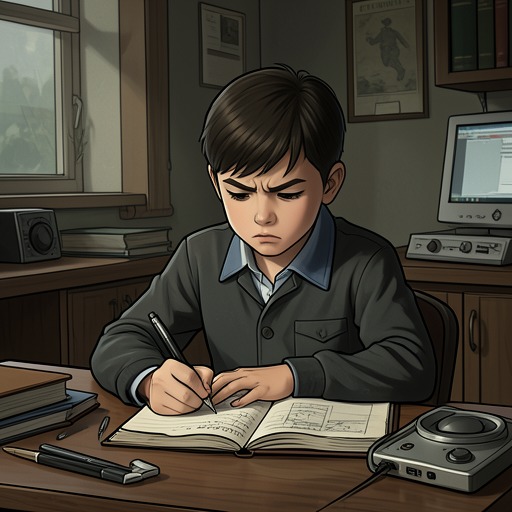
Thad was born and raised in the Ridgeway section of Bergenfield. In 1960, at eleven, he sent a story called “Outside Marty’s House” to a contest sponsored by American Teen magazine. The editors awarded him an Honorable Mention in the Fiction category; they said the story might have won Second Prize had he been old enough to qualify as an American Teen. A registered, insured Certificate of Merit followed two weeks later, its Old English lettering difficult for him to read and its gold seal bearing the magazine’s dancing boy-and-girl logo.
Thad’s mother, Shayla, had the letter and certificate framed with money from her pin-money and hung them over his bed. She showed them to visitors as evidence that her son was destined to become a great writer. Her pride embarrassed Thad, but he loved her too much to object. He came to believe that she might be partly right: he did not know whether he would be great, but he meant to write, both because he was good at it and because the work itself gave him pleasure. In this way, Bergenfield is not merely where Thad grows up; it is where the wish to make a life from words becomes a decision.
The Illness and Its Medical Explanation
The second crisis of 1960 began in August, when Thad developed headaches. By the time school resumed in early September, the pains in his temples and behind his forehead had become prolonged attacks so severe that he lay in a darkened room waiting for them to end. In the weeks that followed, the pain grew worse, and the attacks were commonly preceded by a sound he alone could hear: the distant cheeping of many small birds, which he imagined as sparrows gathering on telephone lines and rooftops.
Four days before Halloween, Thad suffered a convulsion in the family driveway while waiting for the school bus. His lunchbox lay beside him, its fruit and sandwiches spilled across the pavement. His mother ran out but was afraid to touch him. The bus driver, Mr. Reed, had served as a medic in Korea; he opened Thad’s airway before the boy choked on his tongue. An ambulance carried him to Bergenfield County Hospital, where neurologist Hugh Pritchard happened to be in the emergency room.
Pritchard identified a mass in Thad’s prefrontal lobe. It was not a conventional tumor but tissue from a twin that had not been fully absorbed before birth. The tissue had begun growing again, raising intracranial pressure and causing the headaches and seizure. Thad underwent surgery to remove it. The unusual diagnosis gave a physical explanation for the immediate crisis, while the auditory bird-sounds remained part of the account of how his illness announced itself.
A Hometown Revisited Through Memory and Vision
Years later, Thad describes the bird-sound as an auditory sensory precursor associated with the brain lesion: the episodes had been followed by headaches and seizures, and the sound he remembered was specifically that of sparrows. The early medical history therefore resurfaces not as a detached fact but as a possible key to experiences whose significance he and others are trying to understand.
During another seizure in his university office, the sparrows appear to Thad as real. His surroundings give way to Ridgeway, but not to the lived-in suburb he remembers. The neighborhood is silent and deserted, with birds covering the roofs, television antennas, trees, and telephone wires. They also perch on parked cars, the blue mailbox at Duke Street and Marlborough Lane, and the bike rack outside the Duke Street Convenience Store where he had gone as a boy to buy milk and bread for his mother. The precise landmarks of ordinary childhood remain visible inside a vision that has emptied the human world.
The scene ends with the birds poised as though awaiting a command, while Thad’s body remains in the office: he slumps in his chair, foams at the mouth, twitches, and loses consciousness as sparrows line the windows and look in. Bergenfield thus returns in a radically altered form. It is at once the concrete place of Thad’s upbringing and the setting of a vision in which the birds linked to his childhood illness fill an apparently abandoned world, bringing the novel’s medical history into contact with its supernatural threat.
The Past Becomes Evidence
The connection between Bergenfield and Thad’s adult crisis is also pursued through the medical record. While investigating Thad, Sheriff Alan Pangborn writes down Hugh Pritchard’s name and Bergenfield County Hospital as leads, then leaves Pritchard a message recalling that he removed a brain lesion from Thad in 1960, when Thad was eleven. The hometown and hospital become points through which a present-day investigation reaches back into an episode Thad had nearly dismissed as remote.
When Pritchard later recounts the case to Alan, he confirms that the presumed tumor was Thad’s twin and explains that incomplete absorption is rare, especially in the unusual location and renewed growth seen in this case. He suggests that early puberty may have helped trigger the tissue’s growth. The account does not erase the ambiguity of the later bird visions; instead, it establishes the bodily history against which those experiences are interpreted. Bergenfield anchors that history in a specific childhood place, while its uncanny reappearance makes the past feel less finished than Thad had believed.